US FDA vs EU MDR: Key Differences in Medical Device Regulations

Written by: Manuel Mateos CEO and Regulatory Affairs Director, CMC Medical Devices & Drugs S.L.
Medical device manufacturers entering the US and European markets must navigate two different regulatory frameworks: the US Food and Drug Administration (FDA) and the European Union Medical Device Regulation (EU MDR 2017/745).
Although both systems are designed to ensure the safety and performance of medical devices, they differ in classification, market access pathways, clinical evidence, technical documentation, quality management, and post-market requirements.
A device that has already been cleared or approved by the FDA is not automatically compliant with the EU MDR, and CE marking does not represent the same regulatory process as FDA clearance or approval.
This guide explains the main differences between FDA and EU MDR requirements and what manufacturers should consider when placing the same medical device on both markets.
FDA vs EU MDR: Two Different Regulatory Frameworks
The FDA regulates medical devices placed on the US market through a federal regulatory framework. Depending on the type of device and its risk profile, manufacturers may need to follow different pathways, including 510(k) premarket notification, De Novo classification, or Premarket Approval (PMA).
The EU MDR, Regulation (EU) 2017/745, establishes the regulatory framework for medical devices placed on the European market. Instead of an FDA-style clearance system, manufacturers generally demonstrate compliance through a conformity assessment process.
For many devices, this involves assessment by a Notified Body before the manufacturer can affix the CE marking and place the device on the EU market.
The two frameworks also take different approaches to lifecycle management. EU MDR requirements cover areas such as clinical evaluation, risk management, technical documentation, post-market surveillance, vigilance, and, where applicable, post-market clinical follow-up.
Understanding the broader EU MDR 2017/745 requirements is therefore important for manufacturers planning European market access.
FDA vs EU MDR: Medical Device Classification
Classification is one of the most important differences between the two regulatory systems.
How the FDA Classifies Medical Devices
The FDA generally places medical devices into three regulatory classes:
- Class I – generally lower-risk devices
- Class II – moderate-risk devices
- Class III – higher-risk devices
FDA classification depends on factors such as the intended use, indications for use, technological characteristics, and the regulatory controls required to provide reasonable assurance of safety and effectiveness.
The classification of a device is closely connected to the regulatory pathway required for US market access.
How the EU MDR Classifies Medical Devices
Under the EU MDR, medical devices are generally classified into:
- Class I
- Class IIa
- Class IIb
- Class III
Classification is determined according to the rules in Annex VIII of the MDR. Factors can include the device’s intended purpose, duration of use, invasiveness, whether it is active or implantable, and other characteristics relevant to the risk of the device.
The classification affects the conformity assessment procedure and whether a Notified Body is required. Manufacturers dealing with classification questions should assess the applicable MDR classification rules rather than relying on the FDA classification of the same device. For a more detailed explanation of the European classification system, see our EU medical device classification guide.
Are FDA and MDR Classifications Equivalent?
No. FDA and EU MDR classifications are not directly equivalent.
For example, an FDA Class II device does not automatically correspond to an EU MDR Class IIa or Class IIb device. The two systems apply different classification rules and regulatory criteria.
A manufacturer entering both markets should therefore perform a separate classification assessment under each regulatory framework.
For a more detailed explanation of the European system, see our EU medical device classification guide.
FDA vs EU MDR: Key Regulatory Differences
Although both frameworks focus on medical device safety and performance, the way manufacturers demonstrate compliance is different.
Premarket Clearance vs Conformity Assessment
In the US, the applicable FDA pathway depends on the device. Some devices may require 510(k) clearance, while others may follow the De Novo pathway or require Premarket Approval.
Under the EU MDR, manufacturers generally demonstrate compliance through a conformity assessment procedure. Depending on the device classification and applicable requirements, this may involve a Notified Body.
Once the applicable conformity assessment requirements have been completed, the manufacturer can prepare the EU Declaration of Conformity and, where applicable, affix the CE marking.
The processes are therefore not interchangeable. FDA clearance or approval does not replace the EU MDR conformity assessment process.
CE Marking vs FDA Clearance or Approval
CE marking and FDA clearance or approval represent different regulatory concepts.
CE marking indicates that the manufacturer has declared conformity with the applicable European requirements and completed the required conformity assessment procedure.
FDA clearance or approval, by contrast, relates to a specific US regulatory pathway.
Consequently, a CE-marked device is not automatically authorized for the US market, and an FDA-cleared device is not automatically compliant with the EU MDR.
Clinical Evidence
Clinical evidence is another area where the requirements differ.
Under the EU MDR, manufacturers must conduct a clinical evaluation to demonstrate conformity with the relevant safety and performance requirements. Depending on the device and circumstances, clinical investigations and post-market clinical follow-up may also be relevant.
Under the FDA framework, the type and extent of clinical evidence depend on the regulatory pathway and the characteristics of the device.
Clinical data generated for one market may be useful when preparing the regulatory strategy for the other market, but manufacturers should not assume that the same evidence will automatically satisfy all requirements.
Quality Management
Both the FDA and EU MDR require manufacturers to operate appropriate quality management processes.
ISO 13485 is widely used by medical device manufacturers operating in Europe and can provide an important foundation for a compliant quality management system. However, certification to ISO 13485 alone does not mean that all EU MDR requirements have been fulfilled.
Similarly, manufacturers entering the US market must meet the FDA’s applicable quality system requirements.
Companies planning to enter both markets should therefore identify the requirements that can be addressed through a common quality management framework and those that require market-specific controls or documentation.
Post-Market Surveillance
Both systems continue to regulate devices after they reach the market, but their post-market requirements differ.
Under the EU MDR, manufacturers must establish and maintain a post-market surveillance system proportionate to the device and its risks. Depending on the device, this can include complaint handling, vigilance reporting, trend reporting, corrective actions, and post-market clinical follow-up.
The FDA also has post-market requirements, including medical device reporting, corrections and removals, complaint handling, and other surveillance obligations depending on the device and applicable regulations.
Manufacturers selling in both markets therefore need processes that address the requirements of each jurisdiction rather than assuming that one post-market system will automatically satisfy both.
FDA vs EU MDR: What Changes When Entering Both Markets?
Manufacturers planning to place the same device on both the US and European markets should consider the regulatory requirements for both jurisdictions from the beginning of product development.
Intended Purpose
The intended purpose and indications for use are fundamental to regulatory classification and assessment.
Differences in how the device is described or intended to be used can affect classification, clinical evidence, regulatory documentation, and market access requirements.
Classification
The device should be classified independently under the FDA framework and EU MDR rules.
The fact that a device is Class II under the FDA system, for example, does not determine whether it will be Class IIa, IIb, or another class under the EU MDR.
Clinical Evidence
A manufacturer should develop a clinical evidence strategy that considers the requirements of both markets.
Existing clinical data may support regulatory submissions in multiple jurisdictions, but additional evidence or documentation may be necessary depending on the regulatory pathway and device.
Technical Documentation
Manufacturers should also account for differences in regulatory documentation.
EU MDR technical documentation must demonstrate conformity with the applicable General Safety and Performance Requirements and support the manufacturer’s conformity assessment.
FDA submissions and documentation follow the requirements applicable to the relevant US pathway.
A common technical evidence base can be useful, but the final regulatory documentation should be adapted to each market.
Post-Market Requirements
Post-market obligations should also be planned separately.
Manufacturers selling in both markets need processes for complaints, adverse events, vigilance, corrective actions, and other applicable reporting and surveillance activities.
Planning these requirements early can reduce duplication and make it easier to maintain regulatory compliance throughout the device lifecycle.
FDA vs EU MDR: Key Differences at a Glance
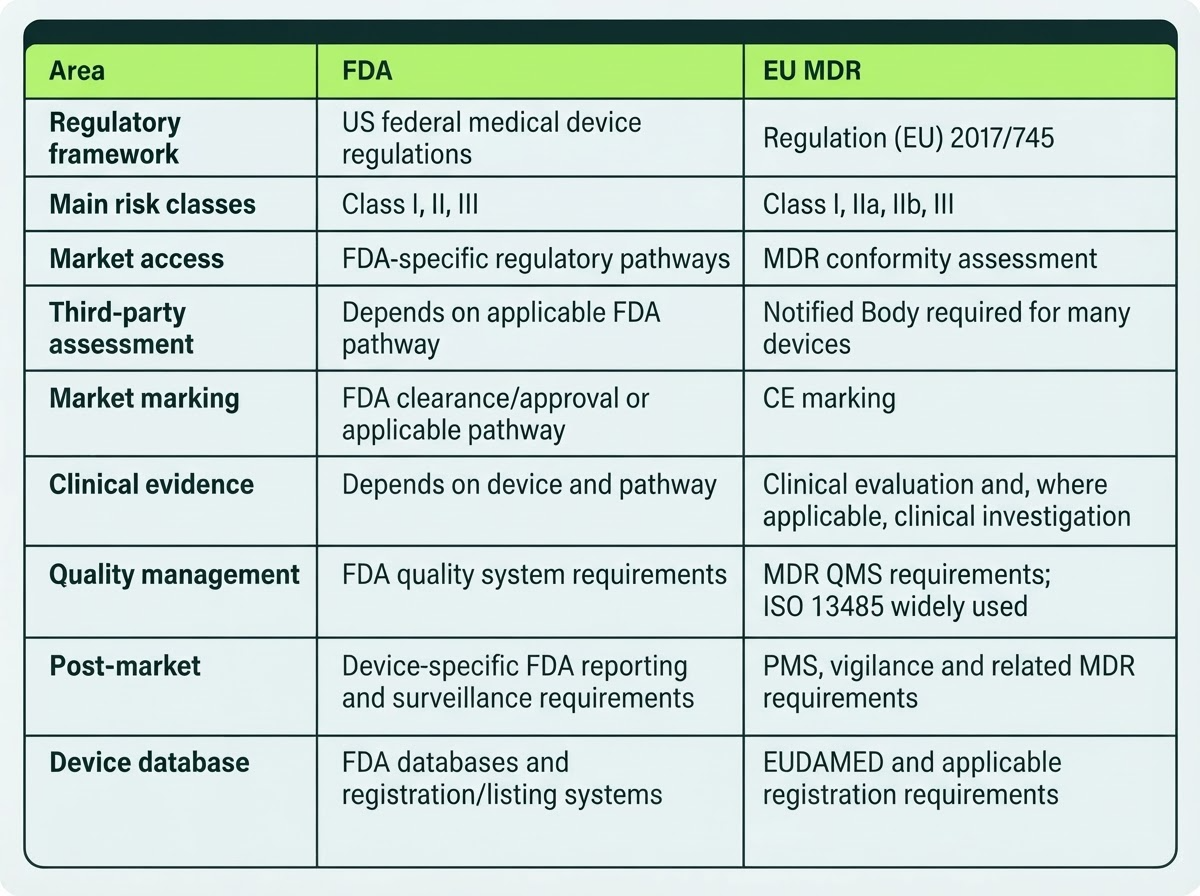
This table provides a high-level comparison only. The exact regulatory requirements depend on the device, intended purpose, classification, regulatory pathway, and other factors.
How CMC Medical Devices Can Support FDA and EU MDR Compliance
Entering both the US and European markets requires a regulatory strategy that accounts for the differences between FDA requirements and the EU MDR.
CMC Medical Devices can support manufacturers with regulatory strategy, medical device classification, technical documentation, clinical and regulatory activities, quality management, and EU MDR compliance.
By identifying regulatory requirements early, manufacturers can build a more efficient strategy for addressing both markets while maintaining the documentation and evidence needed for each jurisdiction.
Frequently Asked Questions
Is EU MDR the same as FDA regulation?
No. The EU MDR and FDA regulations are separate regulatory frameworks with different classification systems, market access procedures, documentation requirements, and post-market obligations.
Is an FDA-cleared device automatically accepted in Europe?
No. FDA clearance or approval does not automatically demonstrate compliance with the EU MDR. Manufacturers must meet the applicable European requirements before placing the device on the EU market.
Is CE marking equivalent to FDA approval?
No. CE marking and FDA clearance or approval result from different regulatory processes and should not be treated as equivalent certifications.
Can the same clinical data be used for FDA and EU MDR?
Clinical data generated for one market may be relevant to the other, but its suitability must be assessed against the requirements of the applicable regulatory framework. Additional evidence or analysis may be required.
Is FDA Class II equivalent to EU MDR Class IIa or IIb?
No. FDA and EU MDR classification systems use different rules and criteria. A device classified as Class II by the FDA must be assessed independently under the EU MDR classification rules.