MDSAP Explained: One Audit for 5 Markets (US, Canada, Brazil, Japan, Australia)

Written by: Manuel Mateos CEO and Regulatory Affairs Director, CMC Medical Devices & Drugs S.L.
Obtaining regulatory approval in multiple international markets often means dealing with a barrage of redundant Quality Management System (QMS) audits. For manufacturers looking to expand globally, this replication of effort consumes valuable time, capital, and resources.
The Medical Device Single Audit Program (MDSAP) solves this issue. It allows a single, comprehensive QMS audit to satisfy the regulatory requirements of up to five major global markets simultaneously.
What is the Medical Device Single Audit Program (MDSAP)?
MDSAP is a program developed by the International Medical Device Regulators Forum (IMDRF). It allows a recognized, third-party Auditing Organization (AO) to conduct a single QMS audit of a medical device manufacturer that fulfills the compliance requirements of all participating regulatory authorities.
Important Clarification: CMC Medical Devices is a specialized regulatory consultancy, not an Auditing Organization (AO). We do not issue MDSAP certificates or conduct official certification audits ourselves. Instead, we provide the comprehensive technical consulting, gap analysis, and QMS preparation services required to help your organization successfully pass an official AO audit.
The 5 MDSAP Countries and Their Regulatory Authorities
Five global regulatory authorities participate in the program, each using MDSAP audit reports to satisfy their local requirements in specific ways:
- United States (FDA): Accepts MDSAP audits as a substitute for routine, scheduled FDA inspections (under 21 CFR Part 820 / QMSR).
- Canada (Health Canada): MDSAP certification is mandatory for Class II, III, and IV medical device manufacturers active in the Canadian market. It completely replaced the old CMDCAS system.
- Brazil (ANVISA): Uses MDSAP audits to bypass physical, pre-market BGMP (Brazilian Good Manufacturing Practices) inspections, accelerating the registration timeline.
- Japan (MHLW / PMDA): Accepts MDSAP reports to waive on-site QMS compliance audits under MHLW Ordinance 169.
- Australia (TGA): Uses MDSAP reports to issue TGA Conformity Assessment Certificates, reducing both review times and application fees.
Note on the European Union: The EU is currently an Official Observer of MDSAP, not a full member. Because EU Notified Bodies cannot delegate conformity assessments to third-party AOs under the MDR/IVDR, you must still undergo separate CE marking QMS audits.
However, trade associations are actively pushing for change. To understand the political landscape and potential future changes, you can read our detailed breakdown on the European Union and MDSAP.
MDSAP vs. ISO 13485: What is the Difference?
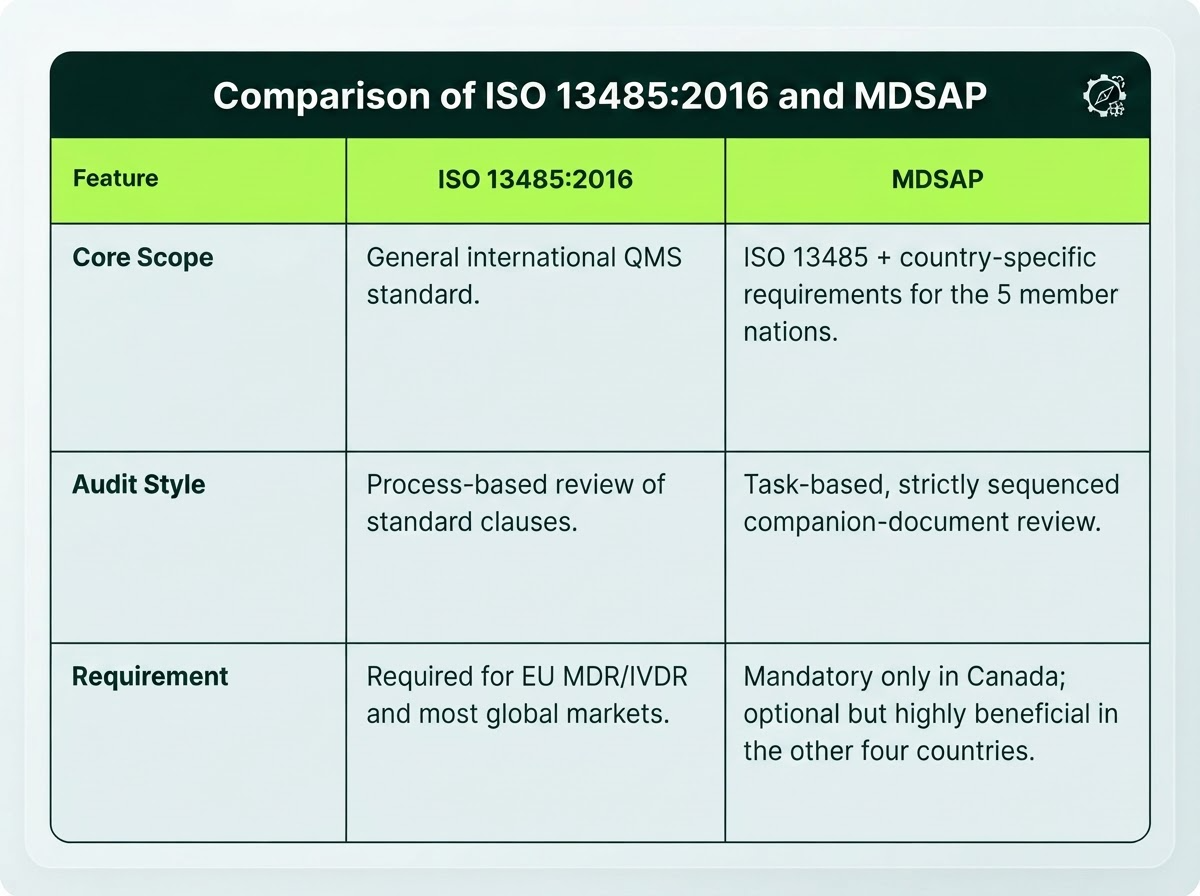
MDSAP is not a replacement for ISO 13485; rather, it is built directly on top of it. It takes the core international quality standard and layers on specific local regulations for the five member countries.
To transition successfully, your quality team must build upon their standard ISO framework. If you need support establishing this baseline, you can explore our specialized ISO 13485 Implementation Services to structure your baseline processes to meet these combined regulatory expectations.
The 7 Core Processes of an MDSAP Audit
Auditors do not navigate your QMS at random. They follow a strict, task-based sequence consisting of seven core processes:
- Management: Evaluates executive commitment, resources, quality policies, and internal audits.
- Device Marketing Authorization: Confirms that the manufacturer has registered their devices and obtained appropriate clearances (e.g., US 510(k), Canadian MDL) in target markets.
- Measurement, Analysis, and Improvement (CAPA): Evaluates how the company handles non-conformities, root-cause investigations, and corrective actions.
- Medical Device Adverse Events and Advisory Notices: Reviews how the company reports field safety issues and recalls to individual country authorities within mandated legal deadlines.
- Design and Development: Checks design controls, risk management (ISO 14971), and validation records.
- Production and Service Controls: Reviews manufacturing processes, cleanroom environmental controls, and equipment calibration.
- Purchasing: Focuses on supplier evaluations, control levels, and outsourced service criteria.
Is MDASP Right for Your Company?
Pros:
- Market Consolidation: Replaces up to five individual regulatory audits with one structured audit.
- Faster Entry to Brazil & Japan: Bypasses lengthy local on-site inspector queues.
- Predictable Scheduling: Reduces the operational disruptions caused by multiple unannounced or randomly scheduled regulatory inspections.
Cons:
- Higher Costs: MDSAP audits are significantly more expensive than standard ISO 13485 audits due to increased preparation and extended auditor hours.
- High Compliance Visibility: An audit failure is visible to all five regulatory bodies, potentially triggering joint regulatory scrutiny.
If you decide to utilize MDSAP to enter multiple countries, keeping up with local registrations remains a separate hurdle. For assistance with clearing your physical devices in these target regions, you can utilize our Global Medical Device Registrations services to manage direct product submissions alongside your new QMS audit strategy.
Step-by-Step Pathway to MDSAP Certification
- Gap Analysis: Review your current ISO 13485 QMS against the MDSAP Audit Model and add missing country-specific rules.
- Select an Auditing Organization (AO): Appoint an approved third-party registrar authorized to perform MDSAP audits (e.g., BSI, TÜV SÜD, SGS).
- Stage 1 Audit: A comprehensive documentation review performed by your AO to ensure QMS readiness.
- Stage 2 Audit: An intensive on-site assessment targeting all 7 core processes.
- Certification & Surveillance: Once any findings are closed, a 3-year certificate is issued, supported by annual surveillance audits.
Need Assistance with MDSAP Compliance?
Transitioning your QMS to satisfy five regulatory bodies simultaneously requires seasoned technical expertise. At CMC Medical Devices, our expert consulting team specializes in guiding manufacturers through the rigorous preparation process. We provide comprehensive MDSAP gap analyses, mock internal audits, and QMS engineering to ensure your transition is smooth and cost-effective.
Planning a global launch? Contact our regulatory experts today to prepare your QMS for MDSAP success.
Frequently Asked Questions (FAQ)
Is MDSAP required to sell in the US?
No. The US FDA accepts MDSAP audits in place of routine inspections, but you can still legally market devices in the US without it.
Can we exclude certain countries from our MDSAP audit?
Yes. You can exclude countries where you have no intention of marketing your devices. However, you must include the specific regulations of every country where you do sell or intend to sell.
Does MDSAP cover product registration?
No. MDSAP is exclusively a QMS audit program. You must still submit local technical registrations (like a US 510(k) or Australian TGA application) to clear your physical devices for sale.
Can CMC Medical Devices issue our MDSAP certificate?
No. MDSAP certificates can only be issued by officially designated Auditing Organizations (AOs). As an independent consultancy, CMC Medical Devices provides the crucial gap analyses, training, and QMS engineering needed to ensure you pass your official AO audit successfully.