COFEPRIS Medical Device Registration in Mexico: A Step-by-Step Guide

Written by: Manuel Mateos CEO and Regulatory Affairs Director, CMC Medical Devices & Drugs S.L.
Mexico is one of the largest healthcare markets in Latin America. To sell medical devices or in vitro diagnostics (IVDs) in Mexico, foreign manufacturers must secure a Sanitary Registration (Registro Sanitario) from COFEPRIS (Comisión Federal para la Protección contra Riesgos Sanitarios), the country’s national health authority.
This guide outlines the classification rules, submission pathways, and key regulatory steps to place your medical devices on the Mexican market.
Device Classification in Mexico
Under Mexico’s General Health Law (Ley General de Salud) and the Pharmacopoeia of the United States of Mexico (FEUM), medical devices and IVDs are divided into three main risk classes:
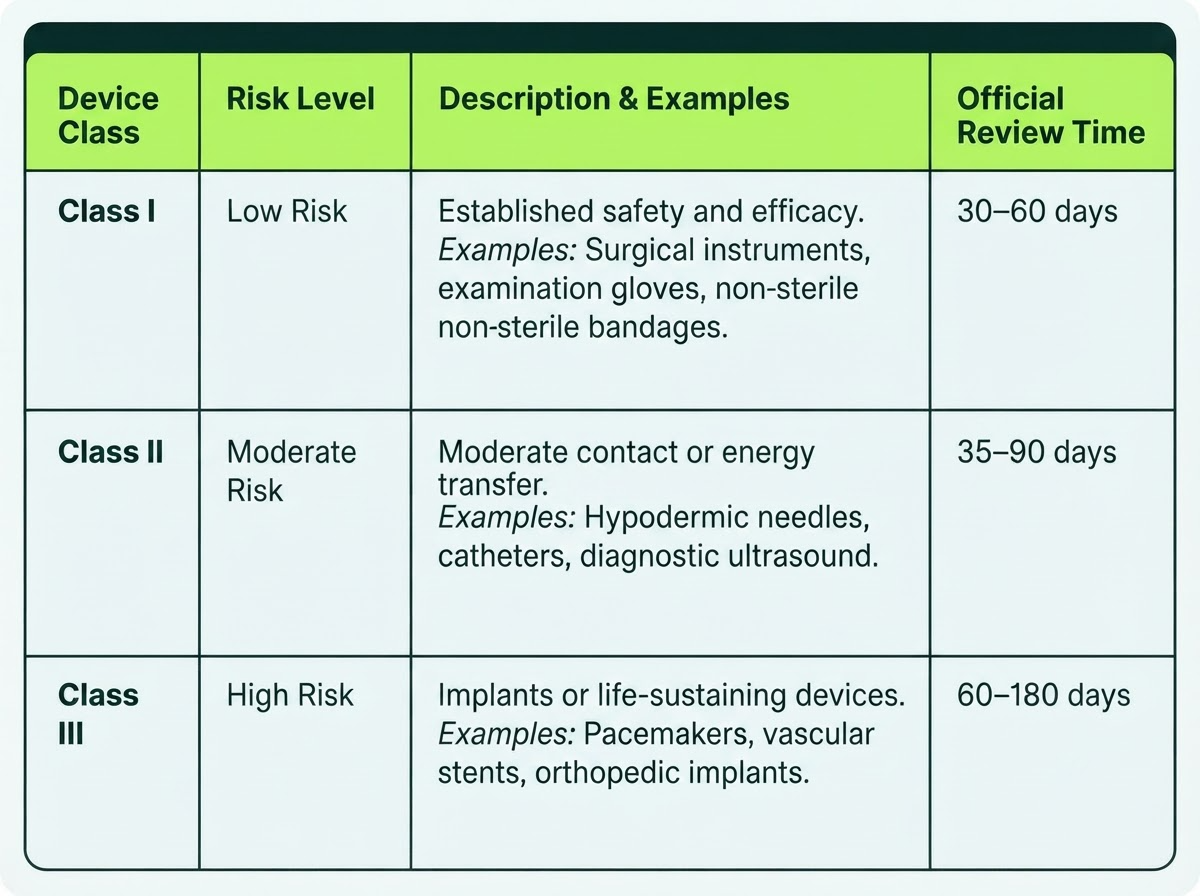
Low-Risk Exemptions: Certain minimal-risk items (Listado de Insumos de Bajo Riesgo) do not require a Sanitary Registration. They only require a simplified notification of operation (Aviso de Funcionamiento).
The Mexico Registration Holder (MRH) Requirement
Foreign manufacturers without a registered business entity in Mexico cannot hold a Sanitary Registration directly. You must appoint a Mexico Registration Holder (MRH)—a local legal representative responsible for your product in Mexico.
Key Responsibilities of the MRH:
- Submits the technical dossier to COFEPRIS.
- Holds legal title to the Registro Sanitario.
- Manages local Technovigilance (Tecnovigilancia) under NOM-240-SSA1.
- Issues import authorization letters to your chosen commercial distributors.
Strategic Tip: Choose an Independent MRH
Appointing a local distributor as your MRH locks your registration to that specific distributor. If commercial disputes arise, transferring the registration requires their explicit consent. Appointing an independent MRH protects your intellectual property and allows you to work with multiple distributors freely.
Registration Pathways: Standard vs. Fast-Track
COFEPRIS offers two main routes for registration:
Standard Pathway (Ruta Ordinaria)
For products without prior approval from recognized reference countries. The dossier undergoes full technical and clinical evaluation directly by COFEPRIS.
Fast-Track Equivalence Pathways (Acuerdos de Equivalencia)
If your device is already cleared in specific reference markets, you can leverage abridged review pathways:
- US FDA Clearance: 510(k), PMA, or De Novo.
- Health Canada: Medical Device License (MDL).
- Japan MHLW/PMDA: Approval or certification.
Note: While CE marking under EU MDR is valid technical evidence for standard submissions, there is currently no formal bilateral Equivalence Agreement between Mexico and the EU.
Accelerating Approvals with Third-Party Reviewers (Terceros Autorizados)
To avoid long agency backlogs, manufacturers can hire a COFEPRIS-accredited Third-Party Reviewer (Tercero Autorizado). They audit the technical dossier and issue a Technical Favorable Report (Informe Técnico Favorable – ITF), significantly reducing COFEPRIS review times.
Technical Dossier Requirements
Submissions must be written in Spanish (or include certified Spanish translations) and contain:
Administrative Files:
- Apostilled Certificate to Foreign Government (CFG) or Free Sale Certificate (FSC).
- ISO 13485 certificate (ensuring ISO 13485 quality system compliance)
- Apostilled Power of Attorney appointing the MRH.
Technical & Testing Data:
- Design descriptions, material specs, and manufacturing processes.
- Biocompatibility, sterilization, and software validation reports (if applicable).
Clinical Data:
- Clinical evaluation reports or clinical data summaries (for Class II and III).
Labeling & IFU (NOM-137-SSA1):
- Spanish packaging artwork and Instructions for Use (IFU) meeting standard NOM-137-SSA1.
Step-by-Step Registration Process
- Classify Your Product: Confirm the risk class and check if an Equivalence Pathway applies.
- Appoint an MRH: Sign a representation agreement and execute an apostilled Power of Attorney.
- Compile the Dossier: Gather technical data, complete Spanish translations, and adapt labeling.
- Audit & Submit: (Optional) Obtain an ITF from a Third-Party Reviewer, then file with COFEPRIS.
- Obtain Approval: COFEPRIS grants the Registro Sanitario once review requirements are met.
Renewals and Technovigilance
- 5-Year Validity: Registrations are valid for 5 years. Renewal applications (Prórroga) must be filed at least 150 business days before expiration.
- Technovigilance (NOM-240-SSA1): Registration holders must maintain a localized post-market surveillance system to log, investigate, and report adverse events to COFEPRIS.
How CMC Medical Devices Can Help
CMC Medical Devices provides end-to-end support through our global medical device registration services or medical device and IVD manufacturers entering the Mexican market:
- Product classification and pathway strategy.
- Independent Mexico Registration Holder (MRH) representation.
- Technical dossier preparation, translation, and labeling compliance (NOM-137-SSA1).
- Coordination with accredited Third-Party Reviewers (Terceros Autorizados).
- Post-market Technovigilance (NOM-240-SSA1) and registration renewals.
Contact our regulatory experts to launch your medical devices in Mexico.
Frequently Asked Questions (FAQ)
Does a CE mark under EU MDR allow fast-track approval in Mexico?
No. CE marking is accepted as technical proof in the standard review pathway, but fast-track Equivalence Agreements are currently limited to US FDA, Health Canada, and Japan MHLW approvals.
How long does COFEPRIS registration take?
Direct submissions to COFEPRIS can take 6 to 18 months due to agency review backlogs. Using an accredited Third-Party Reviewer (Tercero Autorizado) typically reduces processing times to 3 to 7 months.
Can I change my local distributor in Mexico?
Yes, provided your Sanitary Registration is held by an independent Mexico Registration Holder (MRH). If your distributor holds the registration, transferring it requires their written consent.