ISO 20916 Explained: Clinical Performance Studies for IVDs

Written by: Manuel Mateos CEO and Regulatory Affairs Director, CMC Medical Devices & Drugs S.L.
Demonstrating clinical performance under the In Vitro Diagnostic Medical Devices Regulation (EU) 2017/746 (IVDR) requires robust scientific evidence generated through methodologically sound and ethically compliant clinical performance studies. While the IVDR outlines the overarching legal requirements for clinical evidence, ISO 20916 serves as the international gold standard for designing, conducting, monitoring, and reporting these studies.
Published as ISO 20916:2019 and harmonized in Europe as EN ISO 20916:2024, this standard defines Good Study Practice (GSP) for in vitro diagnostic (IVD) medical devices utilizing human specimens. Functioning as the IVD counterpart to ISO 14155 (which covers non-IVD medical devices), ISO 20916 provides the operational roadmap needed to satisfy Notified Body expectations and global regulatory requirements.
What Is ISO 20916?
ISO 20916, titled “In vitro diagnostic medical devices — Clinical performance studies using specimens from human subjects — Good study practice,” establishes scientific and ethical quality standards for IVD clinical investigations.
The primary goals of ISO 20916 are:
- Data Integrity and Quality: Ensuring that clinical performance studies produce reliable, repeatable, and statistically valid data regarding diagnostic sensitivity, diagnostic specificity, accuracy, and operational performance.
- Subject Protection: Safeguarding the rights, safety, dignity, and well-being of human participants who provide biological specimens (such as blood, tissue, saliva, or urine) for diagnostic evaluation.
With the release of EN ISO 20916:2024, European standardizers included Annex ZA, which explicitly maps the standard’s clauses to the mandatory requirements of EU IVDR 2017/746 (specifically Annex XIII and Annex XIV). Fulfilling the requirements of EN ISO 20916 confers a formal presumption of conformity with corresponding IVDR clinical study mandates.
Legal Requirements vs. Technical Standards: IVDR vs. ISO 20916
Understanding the distinction between mandatory legislation, harmonized standards, and interpretive guidance is critical for regulatory strategy.
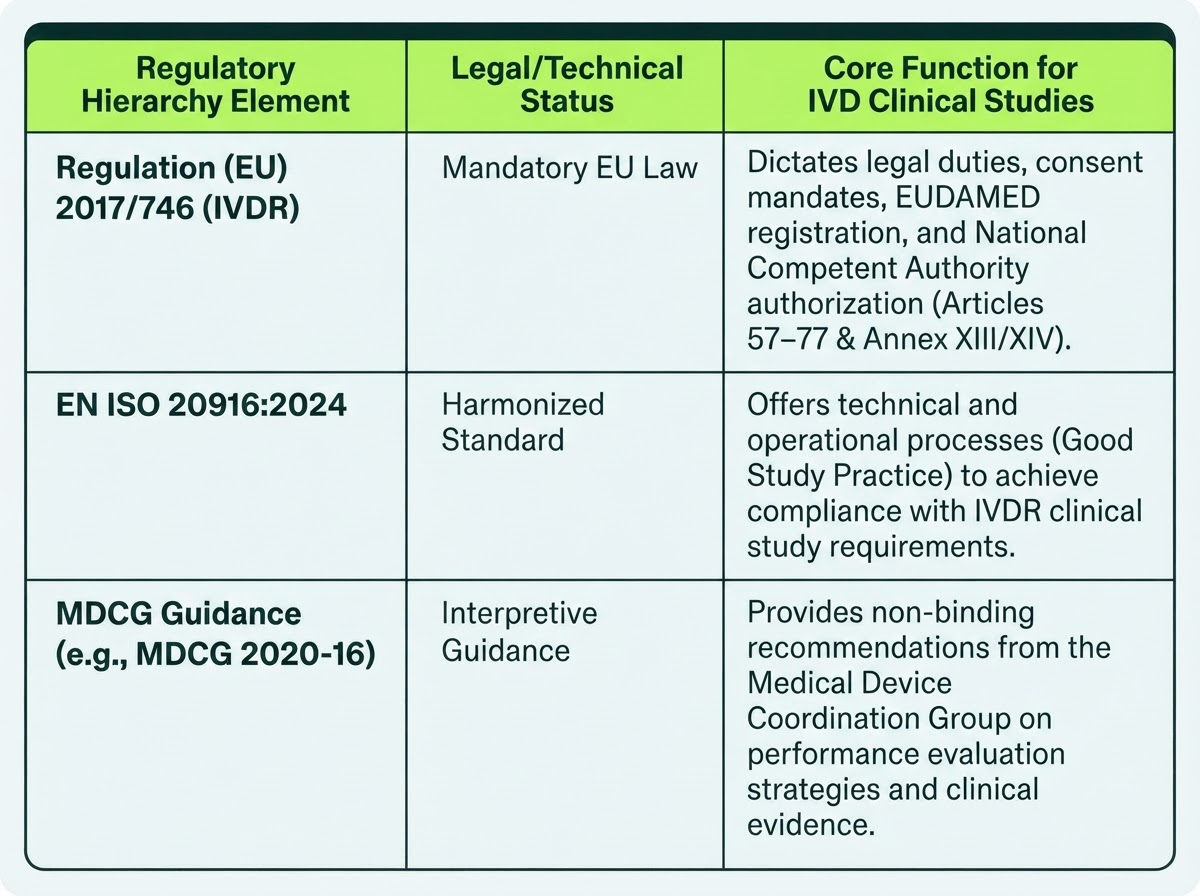
While the IVDR specifies what must be achieved legally, ISO 20916 details how to execute study operations in the laboratory and clinic.
Risk-Based Categorization of IVD Clinical Performance Studies
Not all IVD performance studies carry the same ethical or operational risk profile. ISO 20916 establishes a three-tiered risk classification model based on how specimens are acquired and whether the diagnostic results impact clinical decision-making.
Category A: Non-Interventional Studies (Low Risk)
- Definition: Studies using leftover, anonymized, or archived biological specimens obtained during routine medical care, without additional diagnostic procedures or physical risks to the participant.
- Requirements: Simplified administrative requirements. Ethical review requirements vary by jurisdiction, but informed consent may be waived under specific local data protection rules if specimens are completely anonymized or de-identified.
Category B: Minimal Risk Studies
- Definition: Studies involving additional invasive sampling (e.g., an extra blood draw or additional swab) solely for research purposes, but where test results are not used for clinical management or patient treatment decisions.
- Requirements: Full Clinical Performance Study Plan (CPSP), mandatory Informed Consent, and formal Ethics Committee approval.
Category C: High Risk / Interventional Studies
- Definition: Studies where test results actively guide patient treatment, clinical management decisions, or companion diagnostic selection, OR studies involving invasive sampling carrying significant physical risk.
- Requirements: Comprehensive CPSP, active clinical monitoring, explicit Informed Consent, Ethics Committee approval, and mandatory authorization from the relevant National Competent Authority (aligning with IVDR Article 58 requirements).
6 Steps to Execute an ISO 20916 Compliant Performance Study
Step 1: Define Intended Purpose and Performance Claims
Establish the IVD device’s intended purpose, target analyte, intended user, target patient population, and analytical performance metrics (e.g., limit of detection, exclusivity, linearity) before designing the clinical study.
Step 2: Formulate the Clinical Performance Study Plan (CPSP)
The CPSP is the foundational operational protocol required by ISO 20916 (Section 5) and IVDR Annex XIII Section 2.3. Key elements include:
- Primary and secondary clinical endpoints (e.g., diagnostic sensitivity, specificity, positive predictive value).
- Methodological rationale for sample size calculation and statistical power.
- Specimen collection, handling, storage, transport, and pre-analytical control protocols.
- Reference standard selection (comparator assay or clinical reference diagnosis).
Step 3: Secure Regulatory and Ethical Approvals
For Category B and C studies, ethics committee approval is mandatory. In the EU, studies falling under IVDR Article 58 must submit applications via national clinical trial portals (or EUDAMED when fully operational). Informed consent protocols must strictly adhere to ISO 20916 guidelines and applicable data protection legislation (e.g., GDPR).
Step 4: Qualify Clinical Sites and Equipment
ISO 20916 requires structured site qualification:
- Investigator Competence: Verification of experience, CVs, and Good Clinical Practice/Good Study Practice training.
- Facility Readiness: Equipment qualification, calibration logs, storage temperature monitoring (e.g., -80°C freezers), and biosafety controls.
Step 5: Conduct Active Monitoring and Vigilance
During study execution, monitoring visits verify protocol compliance, data integrity, and sample traceability. ISO 20916 mandates tracking and reporting of:
- Device deficiencies and malfunctions.
- Adverse Events (AEs) and Serious Adverse Events (SAEs) related to specimen collection procedures.
- Protocol deviations and corrective actions.
Step 6: Generate the Clinical Performance Study Report (CPSR)
Upon study completion and data lock, a comprehensive CPSR must be written. The CPSR synthesizes statistical outputs, documents protocol deviations, evaluates clinical diagnostic efficacy, and is integrated directly into the IVD Technical Documentation as part of the Performance Evaluation Report (PER).
Roles and Responsibilities under ISO 20916
ISO 20916 delineates specific duties between the Sponsor (Manufacturer) and the Principal Investigator (PI) to maintain study integrity and data quality.
- Sponsor (Manufacturer) Responsibilities:
- Establish overall study quality management and risk control.
- Draft and maintain the CPSP and Investigator’s Brochure (IB).
- Select qualified trial sites and verify investigator credentials.
- Oversee ongoing study monitoring, auditing, and vigilance reporting.
- Compile the final Clinical Performance Study Report (CPSR).
- Principal Investigator (PI) Responsibilities:
- Protect the safety, rights, and well-being of study participants at the site level.
- Ensure strict adherence to the approved CPSP.
- Obtain written Informed Consent prior to sample collection (where required).
- Guarantee accurate source data recording and specimen chain-of-custody documentation.
Common Audit Pitfalls and Implementation Best Practices
- Control Pre-Analytical Variables: Uncontrolled storage temperatures, excessive freeze-thaw cycles, or unrecorded delays between sample collection and centrifugation are common causes of data rejection by Notified Bodies. Pre-analytical parameters must be defined in the CPSP and strictly logged.
- Document Specimen Provenance: For archived or leftover samples (Category A), maintain traceable documentation proving lawful collection, institutional ethics approval, and valid consent or anonymization waivers.
- Harmonize Terminology: Ensure terminology across the CPSP, Risk Management File (ISO 14971), and Quality Management System (ISO 13485) aligns with EN ISO 20916 Annex ZA and IVDR definitions.
Navigating IVDR clinical performance study requirements and achieving ISO 20916 compliance requires specialized regulatory and clinical expertise. If you need support designing your Clinical Performance Study Plan (CPSP), classifying study risk categories, or preparing clinical evidence for Notified Body review, explore our specialized IVDR consulting services to ensure full market access compliance.
Frequently Asked Questions (FAQ)
What is the difference between ISO 14155 and ISO 20916?
ISO 14155 applies to clinical investigations of non-IVD medical devices evaluated in or on human subjects (e.g., implants, surgical instruments). ISO 20916 specifically addresses in vitro diagnostic medical devices, focusing on specimen collection, pre-analytical sample integrity, analytical correlation, and diagnostic performance metrics.
Is compliance with ISO 20916 mandatory under EU IVDR?
While technical standards are voluntary in principle under EU law, EN ISO 20916:2024 is the harmonized standard for IVD clinical performance studies. Demonstrating compliance with EN ISO 20916 provides a legal “presumption of conformity” with IVDR Annex XIII requirements, making it the standard expected by Notified Bodies during technical documentation audits.
Do studies using archived leftover samples require full ISO 20916 compliance?
Yes, but typically under Category A (low risk). Category A studies require adherence to specimen traceability, pre-analytical documentation, scientific validity, and data integrity rules, even if active clinical trial monitoring or explicit subject intervention is not required.
How does EN ISO 20916:2024 differ from ISO 20916:2019?
The core operational requirements remain identical. However, EN ISO 20916:2024 includes Annex ZA, which explicitly maps clauses of the ISO standard to the corresponding legal requirements of EU Regulation 2017/746 (IVDR Annex XIII and XIV).