EU MDR (2017/745) Fully Explained: Requirements, Timelines & Compliance

Written by: Manuel Mateos CEO and Regulatory Affairs Director, CMC Medical Devices & Drugs S.L.
The European Union Medical Device Regulation (EU MDR) 2017/745 is the main regulatory framework governing medical devices placed on the European Union market. It establishes requirements for the safety, performance, quality, traceability, and ongoing monitoring of medical devices throughout their lifecycle.
Since becoming applicable on 26 May 2021, the MDR has replaced the previous Medical Device Directive (MDD) and Active Implantable Medical Devices Directive (AIMDD), introducing more detailed requirements for manufacturers and other economic operators.
For companies placing medical devices on the EU market, MDR compliance involves more than obtaining a CE mark. Manufacturers must address areas such as device classification, quality management, technical documentation, clinical evaluation, conformity assessment, UDI, EUDAMED and post-market surveillance.
What Is the EU MDR (2017/745)?
Regulation (EU) 2017/745, commonly referred to as the EU MDR, establishes the legal requirements for medical devices marketed in the European Union.
The regulation aims to ensure that medical devices placed on the EU market are safe, perform as intended, and can be appropriately monitored throughout their lifecycle.
Compared with the previous regulatory framework, the MDR places greater emphasis on:
- Clinical evidence and clinical evaluation
- Risk management
- Post-market surveillance
- Device traceability
- Unique Device Identification (UDI)
- Responsibilities of economic operators
- Transparency and access to regulatory information
The MDR applies to a wide range of products, from relatively simple medical devices to implantable products and medical device software.
It is important to distinguish the MDR from the IVDR (Regulation (EU) 2017/746), which establishes the regulatory framework specifically for in vitro diagnostic medical devices.
Who Needs to Comply With the EU MDR?
The MDR establishes responsibilities for the different economic operators involved in placing medical devices on the European market.
Manufacturers
Manufacturers have the primary responsibility for ensuring that their devices comply with the MDR before placing them on the market. Their responsibilities include determining the applicable regulatory pathway, preparing technical documentation, conducting the required clinical evaluation, implementing appropriate quality and risk management processes, completing conformity assessment, and maintaining post-market surveillance.
Manufacturers must also appoint a Person Responsible for Regulatory Compliance (PRRC), where required under the MDR, to oversee key regulatory compliance activities.
Authorised Representatives
Manufacturers established outside the EU generally need to appoint an EU Authorised Representative.
The Authorised Representative has specific responsibilities under the MDR and acts as the manufacturer’s regulatory representative within the European Union.
Importers and Distributors
Importers and distributors also have obligations concerning the devices they place or make available on the EU market. These can include verifying certain information, maintaining appropriate storage and transport conditions, and supporting traceability and regulatory compliance.
Notified Bodies
Depending on the device and its classification, a manufacturer may need to involve a Notified Body in the conformity assessment process.
Not every device requires third-party assessment, making the determination of the correct regulatory pathway an important early step.
What Are the Main EU MDR Requirements?
MDR compliance involves several interconnected regulatory areas rather than a single certification requirement. The main areas include:
Device classification
Manufacturers must determine the applicable risk class according to the MDR classification rules.
Quality management
Manufacturers need appropriate processes to control design, production, quality, suppliers, complaints, changes, and other regulatory activities.
Risk management
Risks associated with the device must be identified, evaluated, controlled, and monitored throughout the product lifecycle.
Technical documentation
Manufacturers must maintain evidence demonstrating that their devices meet the applicable MDR requirements. This includes maintaining appropriate MDR technical documentation demonstrating that the device meets the applicable requirements.
Clinical evaluation
Manufacturers must establish and maintain appropriate clinical evidence supporting the safety and performance of the device.
Conformity assessment
The manufacturer must follow the conformity assessment procedure applicable to the device.
CE marking
Once the applicable conformity requirements have been fulfilled, the manufacturer can affix the CE marking according to the MDR.
UDI and EUDAMED
Manufacturers must meet applicable requirements for device identification and registration, including relevant obligations in EUDAMED.
Post-market surveillance
Compliance continues after market placement through PMS, vigilance, complaint handling, and other lifecycle activities.
These elements are closely connected. For example, device classification can affect the conformity assessment procedure, while clinical and risk-management evidence forms part of the overall demonstration of conformity.
Medical Device Classification Under the EU MDR
Classification is one of the first regulatory decisions a manufacturer should make.
Under the MDR, medical devices are generally classified into four risk classes:
- Class I
- Class IIa
- Class IIb
- Class III
The classification rules are established in Annex VIII of the MDR.
Classification depends on characteristics such as the device’s intended purpose, invasiveness, duration of use, whether it is active or implantable, and other factors specified by the applicable rules.
The classification has important consequences for the regulatory pathway. It can influence the conformity assessment procedure, whether a Notified Body is required, and the level of evidence and documentation expected.
Manufacturers should therefore establish the intended purpose clearly and document the rationale behind the classification.
For a detailed explanation of the classification rules and examples for each class, see our guide: EU Medical Device Classification: Class I, IIa, IIb & III Explained with Examples
EU MDR Conformity Assessment and CE Marking
Once the device classification and applicable requirements have been established, the manufacturer must determine the appropriate conformity assessment procedure.
The procedure depends on the characteristics and classification of the device.
For certain Class I devices, manufacturers may be able to carry out the applicable conformity assessment without a Notified Body, subject to the conditions and exceptions established by the MDR.
For higher-risk devices and certain specific cases, involvement of a Notified Body is required.
The conformity assessment process is used to demonstrate that the device meets the applicable MDR requirements. Depending on the regulatory pathway, this may involve assessment of the manufacturer’s quality management system, technical documentation, clinical evidence, and other aspects of device conformity.
Once the applicable requirements have been fulfilled, the manufacturer prepares the EU Declaration of Conformity and applies the CE marking in accordance with the MDR.
CE marking should therefore be understood as the outcome of a conformity process rather than simply a product registration.
EU MDR Timelines and Transitional Provisions
The MDR became applicable on 26 May 2021, replacing the previous MDD and AIMDD framework.
However, the transition to the MDR has involved different provisions and deadlines depending on the type and regulatory status of the device.
For some legacy devices, transitional arrangements may apply subject to specific conditions. These can depend on factors including the previous regulatory framework, existing certificates, device classification, and compliance with the applicable transitional requirements.
The EU has also introduced subsequent legislative changes affecting certain transition periods and market access conditions.
For this reason, manufacturers should not rely on a single universal MDR deadline. The applicable transition rules should be assessed based on the specific device and its regulatory status.
Manufacturers should also verify current EU legislation and guidance when planning certification, recertification, or transition activities.
EU MDR Compliance: A Practical Roadmap
Although the exact process depends on the device, manufacturers can use the following steps as a general MDR compliance roadmap:
1. Confirm MDR applicability
Determine whether the product falls within the scope of the MDR and identify the applicable regulatory requirements.
2. Define the intended purpose
Clearly establish what the device is intended to do and how it will be used.
3. Determine the classification
Apply the MDR classification rules and document the rationale supporting the selected class.
4. Establish quality and risk management processes
Implement the appropriate quality management and risk management activities for the device and its lifecycle.
5. Prepare technical and clinical documentation
Compile the evidence needed to demonstrate conformity, including applicable safety and performance information and clinical evidence.
6. Select the conformity assessment route
Determine whether the manufacturer can complete the applicable assessment itself or whether a Notified Body is required.
7. Complete CE marking and market access activities
Prepare the EU Declaration of Conformity, complete applicable UDI and registration activities, and place the CE marking on the device where required.
8. Maintain compliance after market placement
Continue monitoring the device through post-market surveillance, vigilance, complaint handling, and updates to regulatory documentation when necessary.
This final step is particularly important because MDR compliance is a lifecycle process rather than a one-time certification exercise.
EU MDR vs IVDR: What Is the Difference?
The MDR and IVDR are separate EU regulations covering different categories of medical devices. Is EUDAMED registration mandatory?
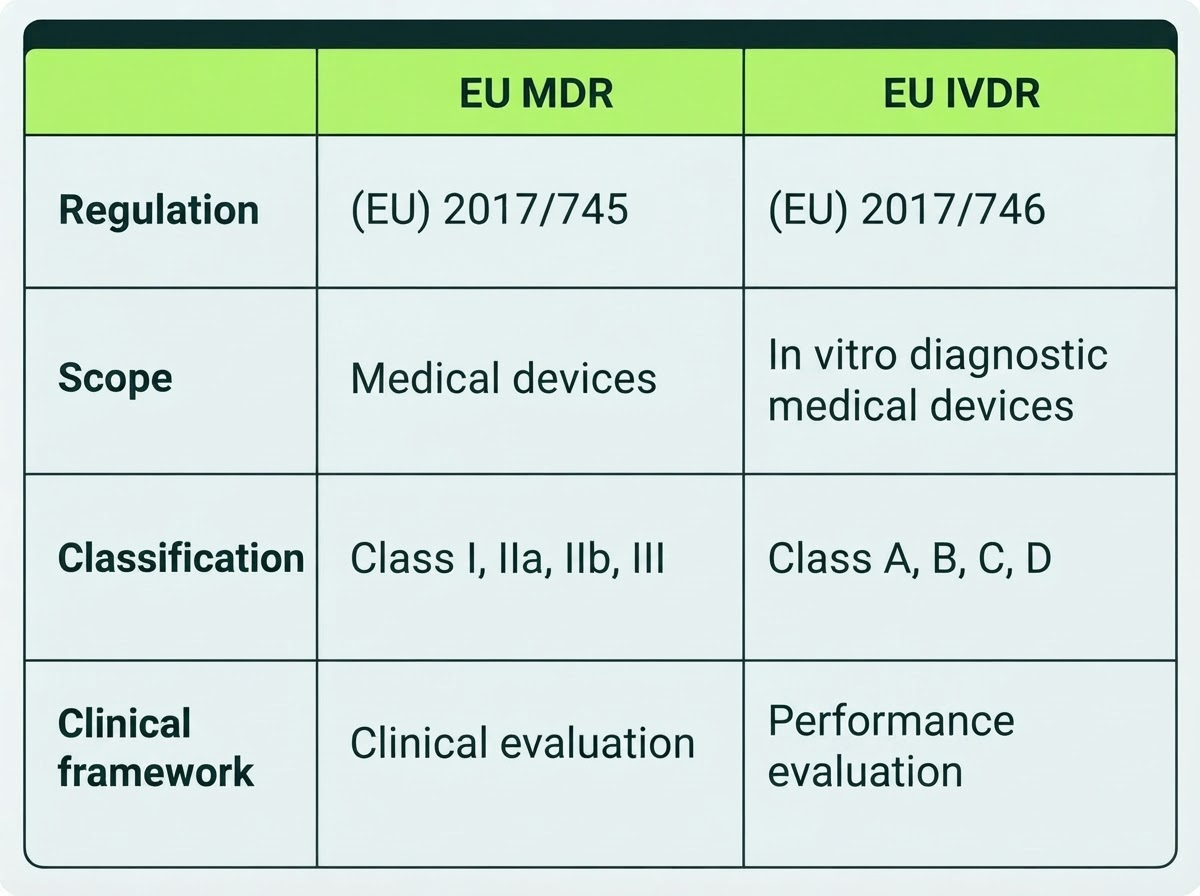
While the two regulations share some concepts, their requirements and regulatory pathways differ.
Manufacturers of IVDs should therefore assess their products specifically under the IVDR rather than assuming that an MDR compliance strategy can be directly applied.
How CMC Medical Devices Can Support EU MDR Compliance
Understanding the MDR is only the first step. Manufacturers need to translate the regulation into a practical regulatory strategy based on their device, classification, intended purpose, clinical evidence, and market access objectives.
CMC Medical Devices supports manufacturers with EU MDR regulatory and compliance activities, including regulatory strategy, device classification, technical documentation, clinical evaluation, quality and regulatory support, and other activities required throughout the medical device lifecycle.
Whether you are developing a new medical device, transitioning an existing product to the MDR, preparing for conformity assessment, or reviewing your current compliance strategy, CMC Medical Devices can help identify the applicable requirements and define the appropriate regulatory pathway.
Frequently Asked Questions
What is the EU MDR?
The EU MDR is Regulation (EU) 2017/745, the European Union’s regulatory framework for medical devices. It establishes requirements covering safety, performance, clinical evidence, technical documentation, conformity assessment, CE marking, traceability, and post-market surveillance.
What are the main MDR requirements?
The main areas include device classification, quality management, risk management, technical documentation, clinical evaluation, conformity assessment, CE marking, UDI, EUDAMED, and post-market surveillance.
Does every medical device need a Notified Body?
No. Certain Class I devices may be eligible for conformity assessment without Notified Body involvement, while higher-risk devices and specific Class I cases require third-party assessment.
Does the MDR apply to non-EU manufacturers?
Yes. Manufacturers established outside the European Union that place applicable medical devices on the EU market must meet the relevant MDR requirements and generally need an EU Authorised Representative.
Is MDR compliance a one-time process?
No. Manufacturers must continue monitoring their devices after market placement and maintain applicable clinical, technical, risk management, vigilance, and post-market surveillance activities.