FDA QMSR Explained: What the New Quality System Regulation Means (and How to Prepare)

Written by: Manuel Mateos CEO and Regulatory Affairs Director, CMC Medical Devices & Drugs S.L.
The wait is over, and the transition window is officially closed. On February 2, 2026, the FDA fully enacted its new Quality Management System Regulation (QMSR).
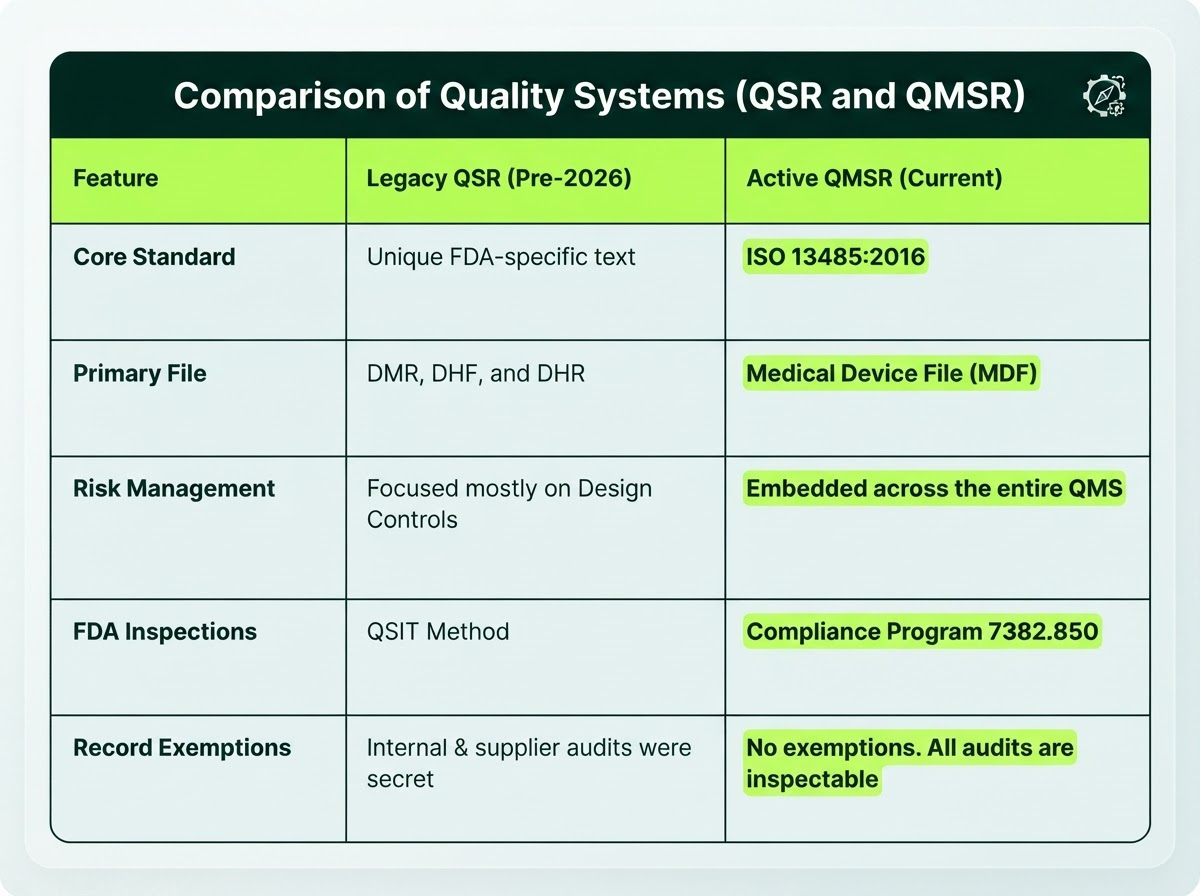
This update completely overhauls the legacy 21 CFR Part 820 (QSR), replacing old, US-centric rules with an internationally harmonized framework based on ISO 13485:2016. For international medical device manufacturers exporting to the United States, compliance is no longer a future goal—it is a current requirement.
Here is a fast, lighter breakdown of what has changed and how to ensure your quality system stays compliant.
QSR vs QMSR: The Core Structural Shift
The biggest change under the new quality management system regulation is something called Incorporation by Reference. Instead of rewriting its own rules from scratch, the FDA has directly adopted the requirements of ISO 13485:2016.
If your company already maintains an ISO 13485 certification for the European market, you are in a great position. However, the FDA has added specific “US overlays” regarding labeling, tracking, and medical device reporting (MDR) that you must still follow.
The 3 Biggest Changes You Need to Know
Say Goodbye to DMR, DHR, and DHF
The classic pillars of FDA documentation are no longer explicitly named in the regulation. Instead, they are wrapped into the Medical Device File (MDF) required by ISO 13485. While you do not need to rename all your old folders, your Quality Manual must clearly show how your legacy files map to the new MDF structure.
Risk Management is Everywhere
Under the old rules, risk management was often treated as an isolated step during product design. The new qmsr fda framework demands a system-wide, risk-based approach. You must now use risk data to dictate your supplier controls, manufacturing validation protocols, and CAPA prioritization paths.
The “Internal Audit Shield” Has Been Removed
This is the most critical operational change for QA managers. Historically, the FDA could not look at your internal quality audits, supplier audits, or management review minutes during a routine inspection.
Under the QMSR, this exemption is gone. FDA investigators now have full authority to read your internal audits and management reviews. Your teams must be trained to document internal issues with absolute objectivity, clarity, and professionalism.
The New FDA Inspection Approach
The FDA has officially retired the old Quality System Inspection Technique (QSIT). Investigators now use Compliance Program 7382.850, which operates much like an ISO process audit. Instead of checking boxes side-by-side, they will track how data flows naturally through your system—from a customer complaint all the way back to design changes and supplier controls.
Quick Compliance Checklist
To ensure your team is fully aligned with the active fda qmsr, verify these four steps immediately:
- Update Your Quality Manual: Ensure it references ISO 13485:2016 clauses and maps legacy terms (DMR/DHR) to the Medical Device File.
- Train Your Team for Inspections: Remind internal auditors and executives that their notes, audit findings, and meeting minutes are now fully visible to FDA inspectors.
- Review US Overlays: Double-check that your system explicitly handles unique device identification (UDI), labeling controls, and Medical Device Reporting (21 CFR Part 803).
- Secure Local Representation: If you are an international manufacturer without a physical US location, ensure your US Agent is prepared to support your updated QMS data flows.
Navigating the New FDA QMSR Era with Confidence
Adapting your quality management system to meet the active FDA QMSR requirements demands both technical precision and strategic foresight. At CMC Medical Devices, we specialize in bridging the gap between European frameworks and US compliance updates.
Whether you need a comprehensive gap assessment, an overhaul of your Quality Manual, or a reliable partner to secure your market access, our team is here to streamline the process.
Explore our specialized FDA Regulatory & Representation USA Services and contact our experts today to ensure your quality system is fully optimized for the new inspection paradigm.
Frequently Asked Questions (FAQ)
Does our ISO 13485 certification mean we skip FDA inspections?
No. The FDA retains its full legal authority to inspect your facility. They will not issue ISO certificates, nor will they accept an ISO certificate instead of an official inspection.
Do we need to throw away our old DHF and DHR files?
Absolutely not. Your historical records are perfectly fine. You just need to ensure that your current Quality Manual includes a clear crosswalk mapping those legacy files to the modern Medical Device File (MDF) requirements.