MDD 93/42/EEC Explained: Legacy Devices and the Transition to MDR

Written by: Manuel Mateos CEO and Regulatory Affairs Director, CMC Medical Devices & Drugs S.L.
For nearly three decades, Council Directive 93/42/EEC (MDD) provided the regulatory framework for most medical devices placed on the European market. Adopted in 1993, it established common safety and performance requirements and introduced the CE marking framework for medical devices across the EU.
The Medical Device Regulation (EU) 2017/745 (MDR) became applicable on 26 May 2021, repealing the MDD and introducing a more comprehensive regulatory framework covering the entire device lifecycle.
However, not all devices certified under the MDD had to transition immediately to the MDR. Transitional provisions allow certain MDD-certified devices, known as “legacy devices,” to remain on the EU market until 2027 or 2028, provided specific conditions are met.
This article explains what MDD 93/42/EEC was, what qualifies as a legacy device, how the MDD and MDR differ, and what manufacturers need to know about the remaining transition requirements.
What Was Council Directive 93/42/EEC (MDD)?
Council Directive 93/42/EEC was adopted on 14 June 1993 to harmonise the regulatory requirements applicable to medical devices across the European Union.
Unlike a directly applicable EU Regulation, the MDD was a Directive, meaning that Member States had to transpose it into national legislation. This allowed for some differences in implementation and enforcement between countries.
Key characteristics of the MDD framework included:
- Essential Requirements: Manufacturers demonstrated compliance with the Essential Requirements in Annex I.
- Risk classification: Devices were classified as Class I, IIa, IIb or III under the classification rules in Annex IX.
- Notified Body involvement: Depending on the device and conformity assessment route, Class I sterile/measuring devices and higher-risk devices required Notified Body involvement.
- CE marking: Compliance with the applicable MDD conformity assessment procedure allowed manufacturers to affix the CE marking and place the device on the EU market.
The MDR replaced this framework with a more detailed regulatory system, particularly strengthening clinical evidence, post-market surveillance, traceability and regulatory oversight.
What Is a “Legacy Device” Under the EU MDR?
“Legacy device” is a regulatory term used in European Commission and MDCG guidance rather than a standalone definition in the MDR itself.
Under Article 120(3) MDR, as amended by Regulation (EU) 2023/607, legacy devices are broadly devices that continue to be placed on the market under the transitional provisions after the MDR became applicable.
They include:
- Devices covered by a valid EC certificate issued under the MDD or AIMDD before 26 May 2021; and
- Certain Class I devices that were self-certified under the MDD before 26 May 2021 but require Notified Body involvement under the MDR.
A device that was self-certified as Class I under the MDD and remains a self-certified Class I device under the MDR does not benefit from the extended transition. It should have complied with the MDR from 26 May 2021.
It is also important to distinguish legacy devices from “old devices”: devices placed on the market before 26 May 2021 under the MDD or AIMDD are treated separately under MDCG guidance.
MDD vs. MDR: Key Regulatory Differences
The transition from MDD to MDR represents a substantial change in the regulatory framework. For a broader overview of the new requirements, see our guide to EU MDR regulations.
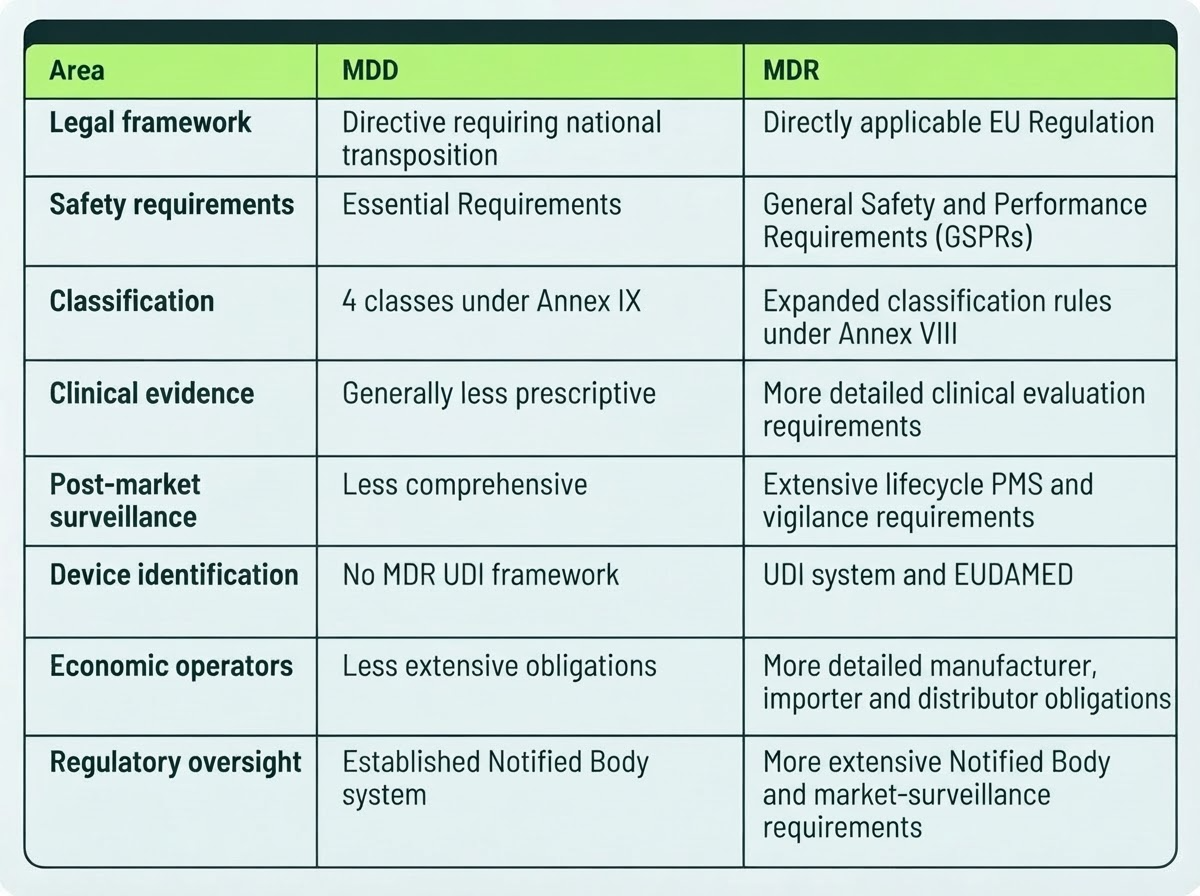
For legacy devices, however, this does not mean that every MDR requirement immediately replaces the MDD requirements. During the transition, the device generally remains subject to the MDD requirements applicable to it, while specific MDR requirements—particularly those relating to PMS, vigilance, market surveillance and registration—also apply.
Extended Transition Periods Under Regulation (EU) 2023/607
Regulation (EU) 2023/607 extended the MDR transition period beyond the original 26 May 2024 deadline.
2027 and 2028 Transition Deadlines
For eligible legacy devices covered by an MDD certificate, the applicable deadline depends on the device’s risk classification:
- 31 December 2027: Class III devices and Class IIb implantable devices, except certain “well-established technologies” such as sutures, staples, dental fillings, dental braces, tooth crowns, screws, plates, wires, pins, clips and connectors.
- 31 December 2028: Other Class IIb devices, Class IIa devices, and Class I devices that are sterile or have a measuring function.
- 31 December 2028: Certain MDD Class I devices for which the MDR conformity assessment requires Notified Body involvement.
There was also a separate transitional provision for Class III custom-made implantable devices, with a deadline of 26 May 2026, subject to the applicable conditions.
2024 Milestones and the Removal of the Sell-Off Deadline
The extended transition was conditional. Manufacturers had to lodge a formal MDR conformity assessment application with a Notified Body by 26 May 2024 and sign a written agreement with the Notified Body by 26 September 2024. Manufacturers relying on the extended transition should therefore be able to demonstrate that these milestones were met and documented.
Regulation (EU) 2023/607 also removed the former “sell-off” deadline. Devices lawfully placed on the market under the applicable transitional provisions can therefore continue to be made available or put into service, subject to the applicable legal conditions.
Mandatory Conditions for Legacy Device Status
The extended transition is conditional, not automatic. Article 120(3c) requires manufacturers to meet several conditions.
Continued Compliance and Device Changes
Continued MDD Compliance
The device must continue to comply with the applicable requirements of the MDD, and the relevant certificate must remain within the validity provisions established by Article 120.
No Significant Changes
There must be no significant change in the design or intended purpose of the device.
Whether a change is significant should be assessed in accordance with MDCG 2020-3 Rev.1, which provides guidance on changes to legacy devices during the transitional period.
No Unacceptable Risk
The device must not present an unacceptable risk to the health or safety of patients, users or other persons, or to other aspects of public health.
QMS, PMS and Vigilance Requirements
MDR-Compliant Quality Management System
Since 26 May 2024, manufacturers benefiting from the extended transition must have a QMS in place that complies with the applicable requirements of MDR Article 10(9).
This does not mean that the entire legacy device technical documentation must already be converted to MDR requirements. MDCG 2021-25 Rev.1 clarifies that legacy devices do not need a full Annex II/III technical documentation revision or a full MDR clinical evaluation merely to satisfy this QMS condition.
MDR Post-Market and Vigilance Requirements
MDR requirements relating to post-market surveillance, market surveillance, vigilance, and registration of economic operators and devices apply to legacy devices.
For example:
- Class I legacy devices are subject to the MDR PMS report requirements under Article 85.
- Class IIa, IIb and III legacy devices are subject to the PSUR requirements under Article 86.
- Serious incidents and FSCA must be handled under the MDR vigilance framework.
The applicable classification for these PMS requirements is generally the device’s MDD classification, even if the device would receive a different classification under the MDR.
Practical Action Plan for Manufacturers
Manufacturers should treat the transition as both a regulatory continuity exercise and a structured move towards full MDR compliance.
Step 1: Review the Portfolio
Confirm whether each device qualifies as a legacy device, identify its applicable transition deadline, review its MDD certificate status and assess any design or intended-purpose changes.
Step 2: Strengthen the QMS and PMS
Ensure the QMS meets the applicable MDR Article 10(9) requirements and that PMS, vigilance, trend reporting and PSUR processes are in place where required.
Step 3: Plan the MDR Technical Transition
Map MDD requirements to MDR GSPRs, update risk management and clinical documentation, review classification, and identify remaining technical gaps.
Step 4: Review EUDAMED and Registration Requirements
Legacy devices remain subject to applicable MDR registration requirements, while legacy devices themselves are not subject to the MDR UDI requirements.
EUDAMED is increasingly important. As of 28 May 2026, the first four EUDAMED modules became mandatory.
Manufacturers should therefore ensure that their applicable actor and device registration obligations are addressed through EUDAMED.
Step 5: Manage the Remaining Transition Timeline
Maintain a transition plan covering the applicable deadline, MDR application status, Notified Body agreement, remaining gaps, certificate status and contingency measures.
Practical Action Plan for Manufacturers
The MDD is no longer the applicable framework for new medical devices, but its requirements remain relevant for eligible legacy devices benefiting from the MDR transitional provisions.
For manufacturers, the key issue is not simply whether an MDD certificate exists. Eligibility for the extended transition depends on meeting the conditions of Article 120 MDR, including continued MDD compliance, no significant changes, an appropriate QMS, the required Notified Body milestones and compliance with applicable MDR PMS, vigilance and registration requirements.
With the 2027 and 2028 transition deadlines approaching, manufacturers should treat legacy-device management as part of a structured MDR transition strategy rather than as a long-term alternative to MDR certification.
CMC Medical Devices can support manufacturers with legacy-device assessments, MDR gap analysis, technical documentation, clinical evaluation, PMS and EUDAMED activities throughout the transition.
Get in contact to discuss your device portfolio and MDR transition requirements.
Frequently Asked Questions
What is the difference between MDD 93/42/EEC and MDR 2017/745?
The MDD was an EU Directive that established harmonised requirements through national transposition. The MDR is a directly applicable EU Regulation with more extensive requirements for clinical evidence, post-market surveillance, traceability, economic operators and regulatory oversight.
Can I make design changes to a legacy device?
Not if the change is considered significant with regard to the design or intended purpose. MDCG 2020-3 Rev.1 provides guidance for determining whether a proposed change is significant. Non-significant changes may be possible without losing legacy status, but they should be documented and assessed appropriately.
Does a self-certified Class I MDD device qualify for the extended transition?
Only in certain circumstances. A Class I MDD device can benefit from the transition if its MDD conformity assessment did not require a Notified Body but its MDR conformity assessment does, and the other Article 120 conditions are met.
Otherwise, a Class I device that remains self-certified under the MDR was required to comply with the MDR from 26 May 2021.
Does the MDR apply to non-EU manufacturers?
Yes. Manufacturers established outside the European Union that place applicable medical devices on the EU market must meet the relevant MDR requirements and generally need an EU Authorised Representative.
What if my MDD certificate expired before 20 March 2023?
Certain certificates that expired before 20 March 2023 can benefit from the extended validity provisions if the conditions specified in Article 120(2), as amended by Regulation (EU) 2023/607, were fulfilled before expiry—for example, where the manufacturer and a Notified Body had signed the required written agreement before the certificate expired.