EU Medical Device Classification: Class I, IIa, IIb & III Explained with Examples

Accurate risk classification forms the foundation of your entire regulatory strategy under the European Medical Device Regulation (EU) 2017/745 (MDR). Specifically, this classification dictates your compliance pathway in the European Union. Consequently, it impacts clinical data requirements and Notified Body audit needs before you can display the CE mark.
Misclassifying a device can result in significant operational setbacks, such as unexpected conformity assessment costs, rejected submissions, or forced market withdrawals.
This guide outlines the core logic of the EU medical device classification framework, analyzes the classification rules set forth in Annex VIII, and provides concrete product examples to help you accurately determine where your device sits.
The Structural Logic of EU MDR Classification
Unlike regulatory frameworks that rely on descriptive product codes, the EU MDR uses a rule-based, risk-driven system. Consequently, the regulation classifies devices into four main tiers based on potential harm to patients or users:
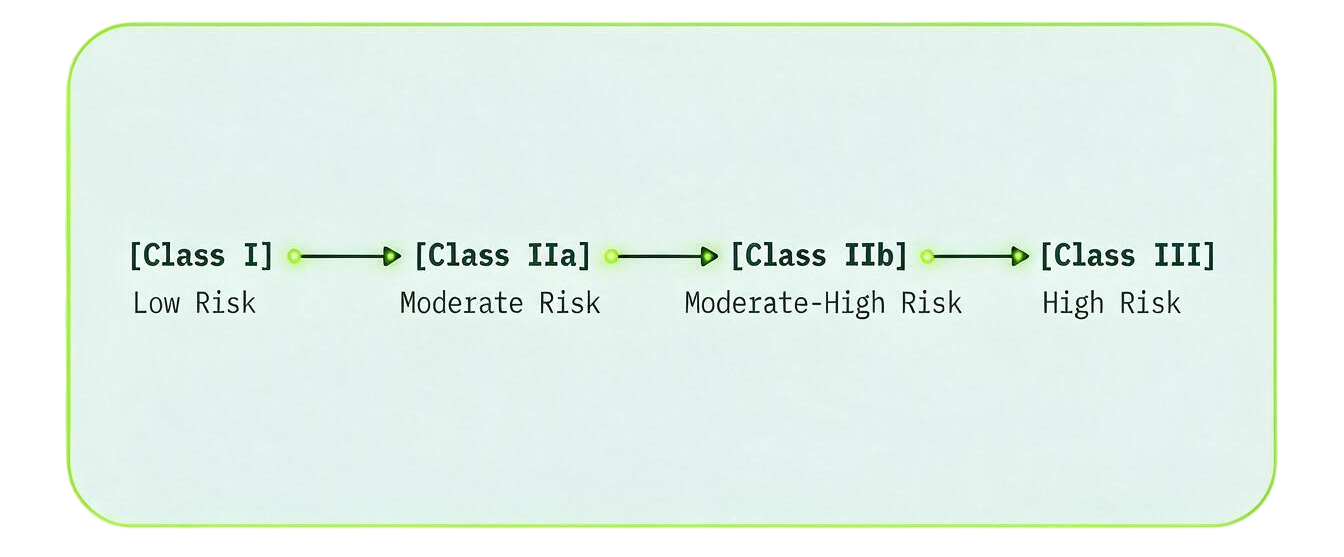
To systematically determine which risk tier your device falls under, the MDR evaluates four main technical parameters:
- Duration of Use: Devices are classified as transient (under 60 minutes), short-term (up to 30 days), or long-term (over 30 days of continuous use).
- Invasiveness: This parameter evaluates how a device enters the body—whether through a natural orifice or via surgical intervention—and how deep it penetrates tissue.
- Anatomical Location: This refers to the specific physiological environment where the device operates, such as surface skin or the central circulatory system.
- Active vs. Passive Technology: This parameter considers whether the device relies on an external power source other than gravity or human energy.
Deconstructing the 22 MDR Classification Rules
Annex VIII of the EU MDR contains 22 specific classification rules—an increase from the 18 rules found under the legacy Medical Device Directive (MDD 93/42/EEC). This expansion reflects tighter oversight regarding modern medical technologies like standalone software, substance-based devices, and nanomaterials.
Non-Invasive Devices (Rules 1–4)
These rules apply to devices that remain outside the body and do not penetrate skin or mucous membranes.
- Rule 1 serves as the default baseline: if no other classification rule applies to a non-invasive device, it is categorized as Class I.
- Rules 2, 3, and 4 cover specialized items that channel, filter, or store blood, fluids, or tissues. Additionally, they cover devices interacting with injured skin.
Invasive Devices (Rules 5–8)
These rules govern products that break the body’s natural protective barriers.
- Rule 5 dictates the classification of devices entering natural orifices (such as the ear, mouth, or nose).
- Rules 6, 7, and 8 govern surgically invasive devices, scaling from transient surgical tools to permanent implants.
Active Devices (Rules 9–13)
Active devices utilize an independent source of power to operate.
- Rule 9 covers active therapeutic devices designed to administer or exchange energy (e.g., muscle stimulators).
- Rule 10 applies to active diagnostic devices used to image or monitor physiological parameters.
- Rule 11 introduces specific parameters for Software as a Medical Device (SaMD), creating a significant regulatory shift that up-classified many software programs previously considered Class I under the MDD.
- Rule 12 governs active devices intended to administer or remove medicines, body liquids, or other substances to or from the body.
- Rule 13 serves as the default baseline for all other active devices.
Special Rules (Rules 14–22)
These rules address highly specific clinical applications or advanced material configurations, including:
- Devices incorporating an ancillary medicinal substance (Rule 14).
- Contraceptive or sexually transmitted infection (STI) prevention devices (Rule 15).
- Specific disinfectants intended for medical devices (Rule 16).
- Active devices specifically intended for recording diagnostic images generated by X-rays (Rule 17).
- Devices utilizing non-viable animal or human tissues (Rule 18).
- Devices incorporating nanomaterials (Rule 19).
- Invasive devices entering the body via surgical intervention to administer medicinal products via delivery systems (Rule 20).
- Devices composed of substances intended to be introduced into the human body via an orifice or applied to skin (Rule 21).
- Active therapeutic devices with an integrated diagnostic function that significantly determines patient management, such as closed-loop systems (Rule 22).
The Priority Rule: If a device has multiple intended purposes or triggers several rules based on its functionality, the strictest rule resulting in the highest risk classification always applies.
Comprehensive Breakdown with Real-World Examples
To align design verification with regulatory expectations, review the standard designations and clinical examples across each category.
Class I: Low Risk
Class I devices carry minimal risk. Standard Class I products allow for manufacturer self-certification. Therefore, you compile technical documentation and sign an EU Declaration of Conformity without a mandatory pre-market Notified Body audit.
However, the MDR designates three specific Class I subclasses. In these cases, a Notified Body must audit the specialized features:
- Class Is (Sterile): Devices delivered in a sterile state (e.g., sterile examination gloves).
- Class Im (Measuring function): Devices that display a direct physiological measurement where inaccuracies could alter patient care (e.g., manual stethoscopes with mechanical displays).
- Class Ir (Reusable surgical instruments): Instruments used in surgical settings that undergo cleaning, disinfection or sterilization cycles between uses (e.g., reusable scalpels, retractors, or surgical scissors).
Class I Examples:
- Manual wheelchairs and hospital beds (Standard Class I)
- External corrective spectacles and frames (Standard Class I)
- Reusable surgical bone chisels and forceps (Class Ir)
- Sterile scalpel blades for single use (Class Is)
- Non-invasive, electronic blood pressure cuffs (Class Im)
Class IIa: Moderate Risk
Class IIa products represent moderate risk. For this class and above, Notified Body intervention is mandatory. Specifically, the Notified Body audits your ISO 13485 QMS and reviews representative technical files before CE marking.
Many active diagnostic tools, short-term invasive items, and standard monitoring systems fall into this classification.
Class IIa Medical Device Examples:
- Diagnostic Ultrasound Probes: Active diagnostic devices used to image internal anatomy or evaluate blood flow parameters.
- Hearing Aids: Active devices designed to correct sensory deficiencies by amplifying sound waves.
- Dental Filling Materials: Composite substances used to repair cavities, remaining in contact with the oral cavity short- or long-term without presenting high systemic toxicity.
- Hypodermic Needles: Surgically invasive devices intended for short-term or transient clinical use to administer fluids.
- Daily or Monthly Contact Lenses: Non-invasive devices placed directly onto the cornea for short-term vision correction.
- Medical Apps for Physiological Monitoring: Standalone software or mobile apps designed to track non-life-critical physiological parameters (e.g., heart rate tracking for diagnostic reference) under Rule 11, where treatment decisions do not carry an immediate, severe risk to the patient.
Class IIb: Moderate-High Risk
Class IIb devices represent a higher level of risk. In this tier, the conformity assessment requires a Notified Body technical review for every distinct model. Generally, this class includes long-term implants, active therapeutic devices delivering energy, and critical diagnostic systems.
Class IIb Examples:
- Infusion Pumps: Active therapeutic devices designed to administer medications, where delivery errors can cause severe systemic reactions.
- Anesthesia Machines: Complex active systems responsible for administering gases and supporting life during surgical procedures.
- Orthopedic Fixation Pins, Plates, and Screws: Implants designed to remain inside the body long-term to stabilize bone architecture.
- Condoms: Special-rule items intended for contraception or the prevention of sexually transmitted diseases.
- Blood Bags: Non-invasive fluid management systems used specifically to collect, store, and channel human blood components.
Class III: High Risk
Class III represents the highest risk tier under the EU MDR. Typically, these devices are life-sustaining or contact the central circulatory or nervous systems. Therefore, they require comprehensive clinical investigations, exhaustive technical file reviews, and post-market clinical follow-up (PMCF) plans.
Class III Examples:
- Implantable Cardioverter-Defibrillators (ICDs) and Pacemakers: Active implantable devices that continuously monitor and regulate cardiac rhythm.
- Coronary Stents: Permanent structural implants placed directly inside the central circulatory system.
- Prosthetic Heart Valves: Critical structural implants designed to replace damaged or diseased biological heart valves.
- Breast Implants: Permanent surgical implants explicitly up-classified to Class III to ensure the highest level of long-term safety data oversight.
- Surgical Mesh: Implants used for tissue reinforcement, elevated to Class III due to historical clinical complications and systemic safety risks.
- High-Criticality Diagnostic Software: Standalone software intended to provide information used to make decisions regarding patient care in life-threatening or irreversible clinical scenarios (e.g., automated stroke detection software used in emergency triage).
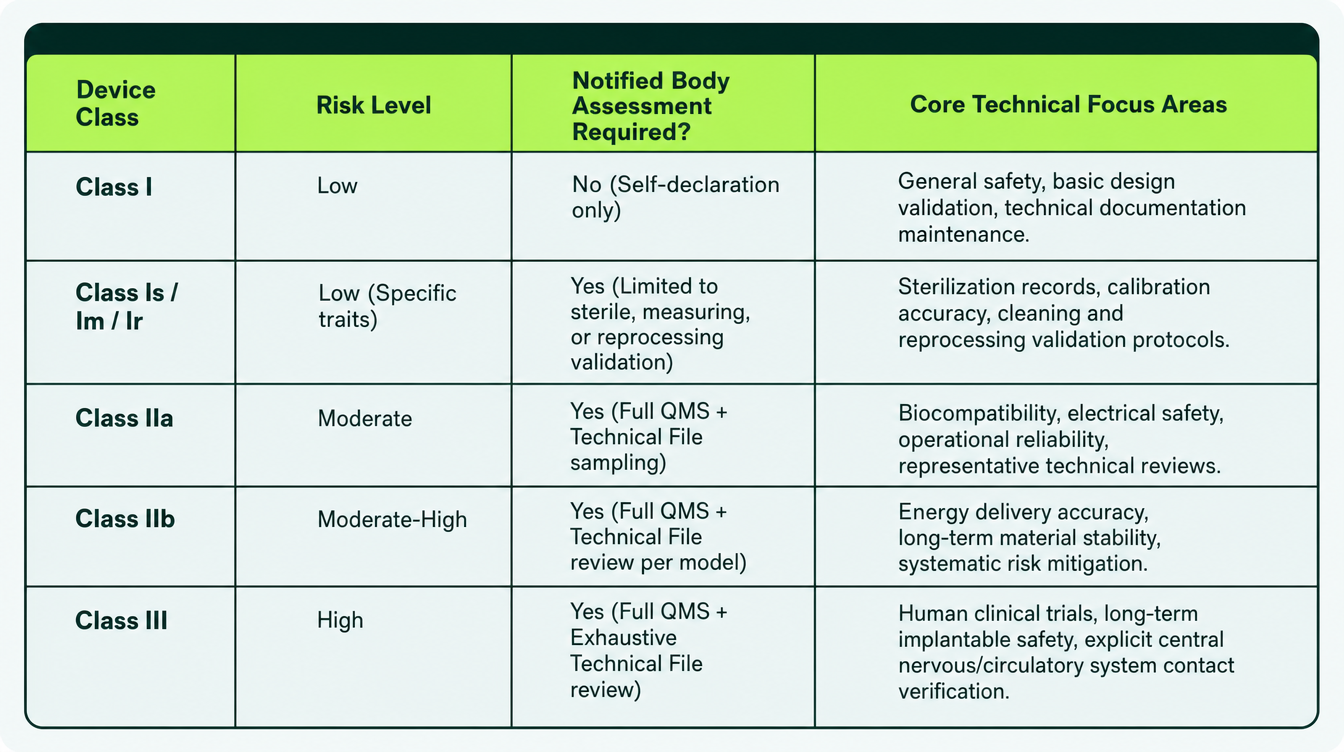
Technical Summary of EU MDR Risk Classes
A Manufacturer’s Checklist for Classification Success
To ensure your classification withstands Notified Body scrutiny, utilize this structured regulatory workflow:
- Freeze the Intended Purpose: First, draft a precise, legally binding definition of what your device does. Specify its target user base, contact duration, and mechanism of action. Ultimately, your classification depends entirely on the clinical claims in your Instructions for Use (IFU).
- Conduct a Sequential Annex VIII Review: First, draft a precise, legally binding definition of what your device does. Specify its target user base, contact duration, and mechanism of action. Ultimately, your classification depends entirely on the clinical claims in your Instructions for Use (IFU).
- Cross-Reference with MDCG Guidance: Additionally, consult the European Commission’s official guidance document, MDCG 2021-24 (Guidance on classification of medical devices). This resource provides concrete guidance for complex boundary cases.
- Isolate the Highest Classification: Finally, if your device triggers both a Class IIa and a Class IIb rule, your final classification defaults to Class IIb.
Next Steps: Moving from Classification to Market Access
Once you verify your device’s risk class, you can project regulatory timelines and budgets. For Class IIa, IIb, and Class III devices, you must establish an ISO 13485 QMS. Furthermore, you must author a Clinical Evaluation Report (CER) and select a designated Notified Body to initiate your conformity assessment.
Ready to Secure Your EU Market Access?
Determining your risk class under EU MDR is only the first step. If you need expert validation of your classification or technical file support, we are here to help.
Explore our EU MDR Consulting Services today. Alternatively, contact our team of senior consultants directly to streamline your pathway to CE marking.
Frequently Asked Questions (FAQ)
How does EU MDR classification differ from US FDA classification?
The underlying methodologies differ significantly. Specifically, the US FDA utilizes product codes linked to historical predicates via the 510(k) pathway. Conversely, the EU MDR relies on 22 risk-based rules outlined in Annex VIII. These rules evaluate variables like invasiveness, duration, location, and energy dependency rather than historical comparison. For an in-depth breakdown, see our detailed guide on US FDA vs EU MDR: Key Differences in Medical Device Classification.
Can standalone medical software be a Class I device under the MDR?
This scenario is rare under current rules. Under Annex VIII, Rule 11, software providing diagnostic or therapeutic information defaults to Class IIa. Furthermore, it can be up-classified to Class IIb or Class III if decisions have life-threatening consequences. Consequently, software remains Class I only if it performs simple, non-diagnostic tracking or raw data storage without analyzing physiological parameters.
What happens if a manufacturer and a Notified Body disagree on a device’s classification?
If a dispute arises during assessment, the matter goes to the Competent Authority of the relevant EU Member State. Specifically, this is the state where the manufacturer or Authorized Representative (EC REP) is established. Ultimately, the Competent Authority makes the final determination on which rule applies.